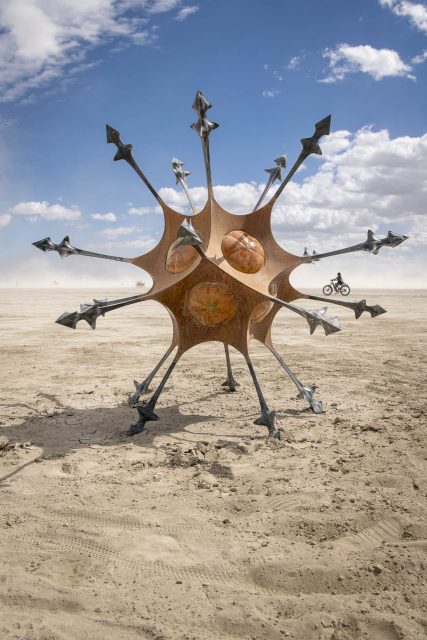
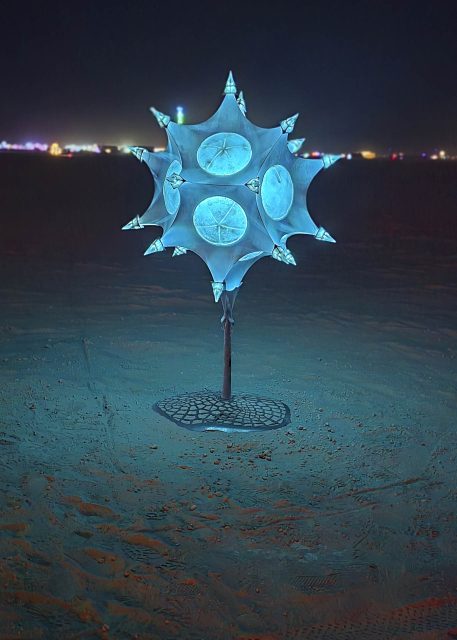
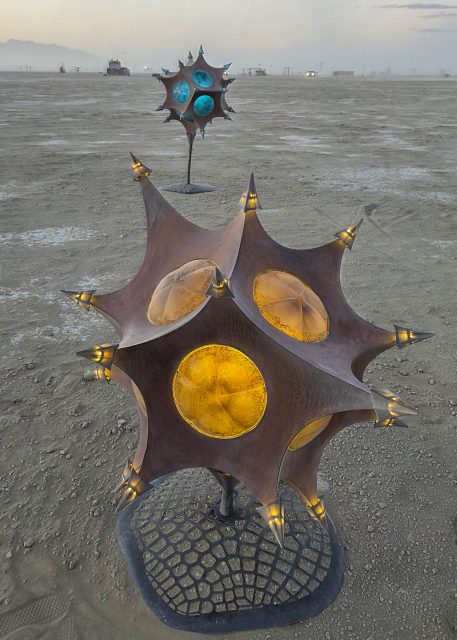
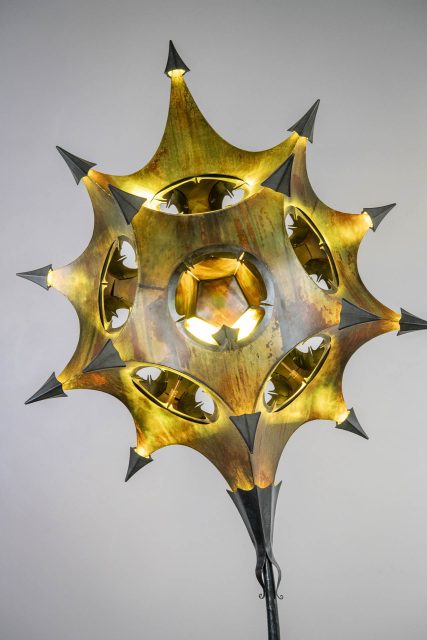
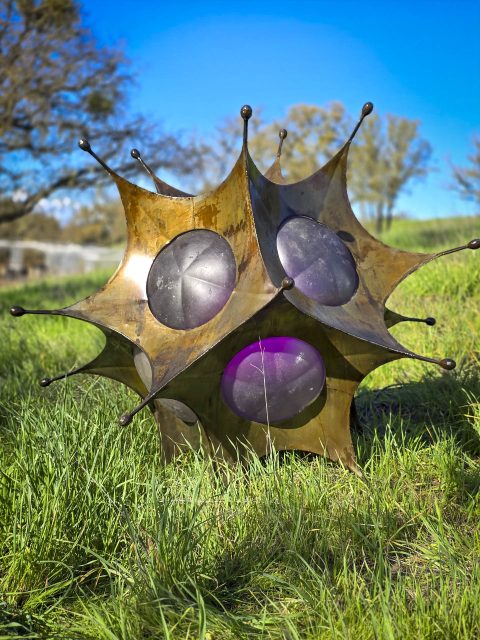
Radiolaria are microscopic marine organisms that have drifted through Earth's oceans for more than 500 million years. Though invisible to the naked eye, they create some of the most intricate and mathematically beautiful structures found in nature. Each organism forms a delicate mineral skeleton — often spherical, radial, or lattice-like — made primarily of silica, producing an endless variety of geometric patterns and symmetrical forms. Found throughout the world's oceans, they exist at every depth, from surface waters to the deep sea. When they die, their silicate skeletons slowly fall to the ocean floor, becoming part of the sedimentary record of the Earth. Their preserved forms are so distinct and abundant that geologists use them to study ancient climates and date rock layers through a process known as stratigraphy. This series of six sculptures draws specifically from the order Spumellaria — the radiolarian order whose spherical, latticed skeletons most closely match the dodecahedron geometry at the heart of this work. Each piece is a full-scale interpretation of a Spumellaria skeleton, ranging from 39 to 70 inches, fabricated in steel with the precision of laser cutting and welding and the irreducible presence of the hand: tips blown hot in the furnace, ball ends hand forged, surfaces weathered to a deep iron patina that carries time in its texture. The six sculptures are named from two pre-Roman Atlantic languages — Basque and Old Irish. The choice is not arbitrary. Both languages predate Latin influence in Western Europe. Both come from peoples who lived at the edge of the Atlantic, who knew the sea the way radiolaria know it — from the inside. Geneticists have traced a deep Iberian ancestry running through the Irish genome, carried north along the Atlantic coast during the Bronze Age. The Basque and the Irish shared a shoreline, a culture, and blood. Their languages share no grammar and no vocabulary, and yet both looked at the same ocean and named it something that sounds like the water itself. Muir. Itsaso. It seemed right that organisms which belong to the sea should carry names from people who belonged to it too. What draws us to radiolarians is the balance between precision and irregularity — how nature produces structures that feel engineered yet alive. Their forms suggest a shared language between biology, mathematics, architecture, and sculpture. Though microscopic in scale, they carry a monumental presence when enlarged, revealing hidden patterns that connect natural systems across time and scale. Our work explores these forms as both scientific inspiration and artistic language, translating the invisible architecture of microscopic life into large-scale sculptural environments of steel, light, texture, and shadow.
Note: Designs can be adjusted in size and height with multiple finish options, along with a variety of available finishes in medium base or candelabra socket sizes, to customize the look of the chandelier. Listed specifications are for the chandelier as shown.